

United Nations member states unanimously adopted the sustainable development agenda in 2015. It aims to ensure development that “meets the needs of the present without compromising the ability of future generations to meet them” (1987 Brundtland Report, “Our Common Future”). This agenda outlines 17 Sustainable Development Goals (SDGs) and sets out 169 targets to be achieved by 2030. They represent the programme’s accountability framework.
None of the 17 Sustainable Development Goals (SDGs) is specifically devoted to human rights. In reality, they are everywhere – at the heart of the social, economic, cultural, civil, and political life of all inhabitants of the world, but also at the centre of contemporary ecological issues, which the United Nations General Assembly endorsed in 2022 through a historic resolution acknowledging the right to a healthy environment as a human right.
According to the Danish Institute for Human Rights (DIHR), 92% of the SDG targets are rooted in international human rights law. The promotion, respect and protection of human rights therefore form the backbone of the SDGs.
‘Strong sustainability’, a prerequisite for preserving nature and the universality of human rights
On the whole, the SDGs combine environmental, economic, human development and governance issues. However, there are several competing visions, based on different economic and environmental assumptions, regarding how to achieve them. These are referred to as “weak” and “strong” sustainability. The latter is a concept that aims to strengthen sustainable development by ensuring that economic policies do not compromise (or sacrifice) human development, the environment or nature.
Unlike weak sustainability (based on the concepts of the substitutability of natural capital), strong sustainability is based on the principle that natural capital is irreplaceable and must be preserved.
Three key principles of strong sustainability stand out:
Within this framework, the human rights-based approach and the approach based on the rights of nature are essential for truly sustainable development. This involves recognising nature – ecosystems and natural entities – as a subject of law.
Today, more than 650 initiatives recognising the rights of nature have been documented. Without these approaches, the current system exacerbates inequalities and threatens the habitability of the planet.
This is documented in several research studies and international conferences organised by the French Development Agency (AFD) whose mission is analysing the intersecting issues between human rights and sustainable development, with specific areas of focus such as the ecological transition, multidimensional inequalities and the rights of nature. The AFD also works with DIHR on other issues relating to human rights and climate policies.
What emerges from this overview is that the (anthropogenic) ecological crisis exacerbates inequalities and severely undermines human rights – both substantive (the right to life, health, food, housing, etc.) and procedural rights (the right to participation, information and redress), primarily among vulnerable populations: children, women, indigenous peoples and local communities, human rights and environmental defenders, migrants and displaced persons.
Environmental governance meanwhile remains inadequate, with governments and the private sector generally limiting themselves to a risk-reduction approach (“no harm done”) that lacks accountability and an integrated, proactive vision of human rights, the right to a healthy environment, and the rights of nature. It thus, appears urgent to come up with other alternative models incorporating accountability, justice (social and environmental) and citizen participation for reconciling ecology and human rights within an eco-centred rather than anthropocentric approach.
Especially now that the planet’s limits have been largely exceeded.
Looking at the planet’s limits from a human rights perspective
These limits (see chart below) define the safe operating space for humanity in relation to the terrestrial ecosystem and are linked to the planet’s biophysical subsystems or processes. Today, 7 out of 9 boundaries have been exceeded. And since the adoption of the SDGs in 2015, 3 have been exceeded.
Stockholm Resilience Centre. Click to zoom.
Beyond the significant impact on the natural world, the implications for human rights are systemic. Take the right to health, for example evidence shows that each “planetary limit” has direct consequences for human and animal health and ecosystems.
As far as human health goes, chemical pollution (pesticides, plastics, persistent organic pollutants) causes a range of chronic illnesses and an increase in cancer cases.
Air pollution alone causes more than 4 million deaths worldwide every year.
Premature deaths linked to heatwaves (climate), malnutrition (changes in the water cycle), soil degradation or the decline in biodiversity further exacerbate the health toll and human mortality, primarily affecting the poorest populations, particularly in a world governed by a profoundly asymmetrical and unequal model.
Inequality as a driving force behind the ecological crisis and the erosion of human rights
According to the World Inequality Lab’s 2025 report on climate inequality, the poorest 50% of the world’s population account for 10% of greenhouse gas (GHG) emissions, which is significantly less than the emissions of the richest 1%. The latter, moreover, are solely responsible for 41% of GHG emissions linked to the ownership of assets (both financial and non-financial).
The poorest 50% are not only the least responsible. They are also the most vulnerable to loss and damage, whilst having the least financial capacity to cope with it. And if we look at income and wealth inequality, we see that the richest 10% of the world’s population harness more income than the remaining 90%. Overall although inequality has been rising sharply within countries for several decades, these findings point to very significant North-South disparities. Yet the greater inequality, the less ability people have to assert their rights.
The inconsistencies of an asymmetrical and unequal model in the 2030 Agenda
Under these circumstances, achieving the expected outcomes of the 2030 Agenda is a long shot. The 2025 United Nations report on the SDGs shows that of the 169 SDG targets, only 18% have been met or are on track to be met by 2030. And 66% of them show marginal progress, stagnation or regression.
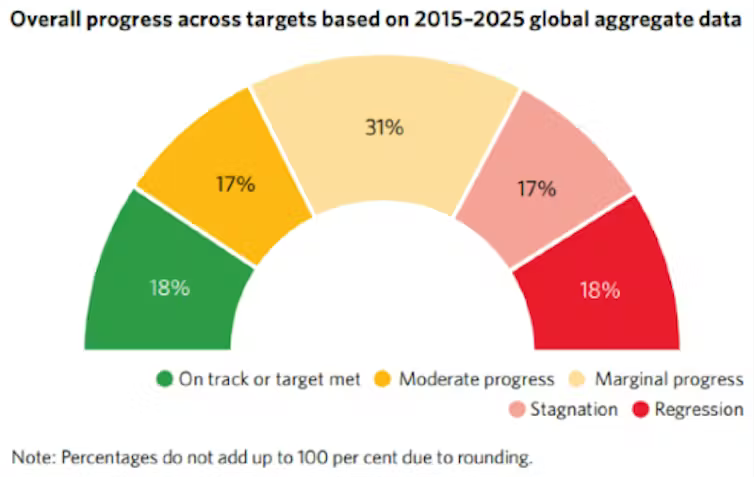
The Sustainable Development Goals Report 2025.
A more detailed analysis, SDG by SDG, shows that several of them will not meet any of their targets by 2030. This is particularly the case for SDG 1 (poverty), 5 (gender), 6 (water), and 16 (peace, justice and strong institutions). Meanwhile, SDGs 2 (hunger), 3 (good health), 4 (quality education), 10 (reduced inequalities) and 13 (climate action) are expected to meet only one target each.
Given that human rights form the backbone of the SDGs, these results demonstrate that issues of justice remain marginal in their operational implementation.
On the other hand, democratic backsliding, the decline in human rights and the extreme narrowing of civic space that is materialising, for example, in censorship and the violent repression of journalists, human rights and environmental defenders, peaceful protesters, etc. – around the world are further obstacles to their achievement.
Today, according to the Civicus Monitor, only 7.2% of the world’s population lives in an “open” or “reduced” civic space. The rest live in a “restricted” (19.9%), repressed (42.3%) or closed (30.7%) civic space.
It is therefore becoming urgent for the international community in general, and development actors in particular, to give full priority to approaches based on human rights and the rights of living things in the implementation of the 2030 Agenda.
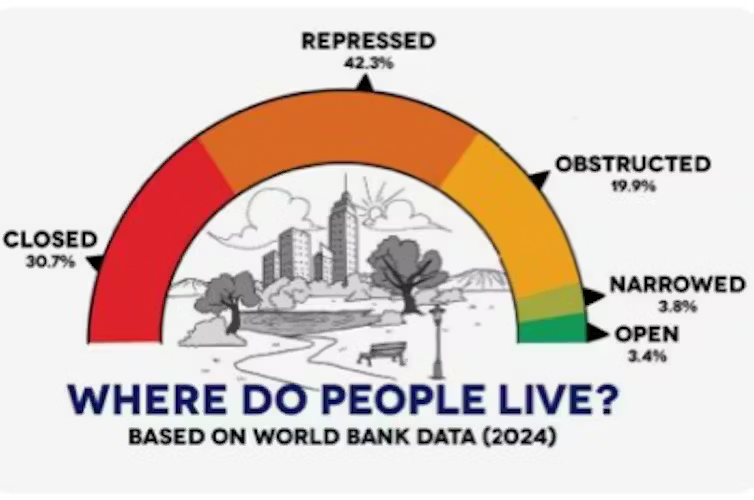
Civicus Monitor
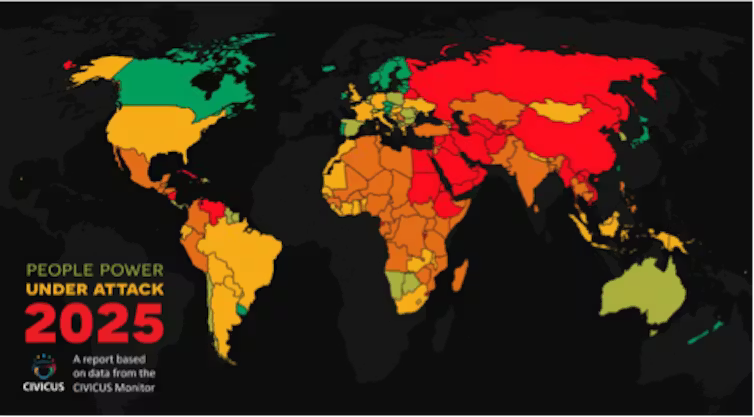
Civicus Monitor
Human rights and the rights of nature: a vital symbiosis for future generations
To achieve this, the challenges associated with the dominant economic model and global governance must be considered. This goes far beyond the legal sphere.
And yet the rights of nature are powerful levers for strengthening human rights and vice versa, as recently recognised by the International Union for Conservation of Nature (IUCN) through the adoption of several resolutions.
With this in mind, the approach based on human and living rights should be integrated into all public policies aimed at achieving SDGs, with a strong focus on sustainability.
This is precisely what the COP15 Kunming-Montreal Decision on Biodiversity states, calling for action to support Mother Earth, that is to say, an “eco-centric and rights-based approach conducive to the implementation of actions aimed at establishing harmonious and complementary relationships between people and nature, promoting the sustainability of all living beings and their communities, and avoiding the commodification of the environmental functions of Mother Earth”.

A weekly e-mail in English featuring expertise from scholars and researchers. It provides an introduction to the diversity of research coming out of the continent and considers some of the key issues facing European countries. Get the newsletter!
Source:
theconversation.com